
How to Check (and Improve) Your Site’s Visibility in AI + Google Search
AI is reshaping SEO.
It’s no longer just about ranking on Google. You need to be visible everywhere people search, including AI models.
The problem is most brands don’t know how—or even if—they’re appearing in LLM outputs. And without that knowledge, it’s impossible to succeed in this new search era.
But once you understand how AI “sees” your brand, you can start shaping that narrative and improving your presence.
Today, I’ll show you how to track a website’s visibility in LLMs and Google using Semrush One—an all-in-one offer to measure, manage, and grow your brand’s visibility across every search surface. And share some tips on how to grow that visibility.
To keep this as clear as possible, I’ll outline the exact approach I would take if I were doing this for the first time.
1. Audit for AI Search Readiness
I’d first use Site Audit to check my AI Search Health score and ensure AI bots can actually access and interpret my content.
And I’d fix common blockers like:
AI crawlers blocked in robots.txt
Missing or misconfigured llms.txt
Weak internal linking
Even the best content won’t get cited if AI can’t access or interpret it. Technical readiness keeps your content visible as AI systems evolve.
2. Do a Visibility Pulse Check
Next, I’d want a quick overview of how my site and its competitors are doing.
For that, I’d use Domain Overview.
Domain Overview highlights both SEO and AI visibility signals. You can see:
How often AI mentions the entered domain
How many pages AI references
Which models (ChatGPT, Gemini, etc.) talk about the entered domain
How much organic traffic the entered domain gets each month
And more.

Run the report for your domain and your rivals to see how you stack up.
Doing this gives you a clear baseline for your visibility across both traditional SEO and AI search, so you can see where you’re already winning and where you need more visibility.
3. Benchmark AI Visibility
Then I’d use the Visibility Overview dashboard to see how my site is performing across AI platforms.
This tool shows your:
Performing Topics: Where you already show up
Topic Opportunities: Where competitors appear but you don’t
Cited Sources: Which sites in your niche AI trusts

This shows exactly where your brand stands in the AI ecosystem—what’s working, what’s missing, and where competitors are getting visibility but you’re not.
4. Find AI Visibility Gaps
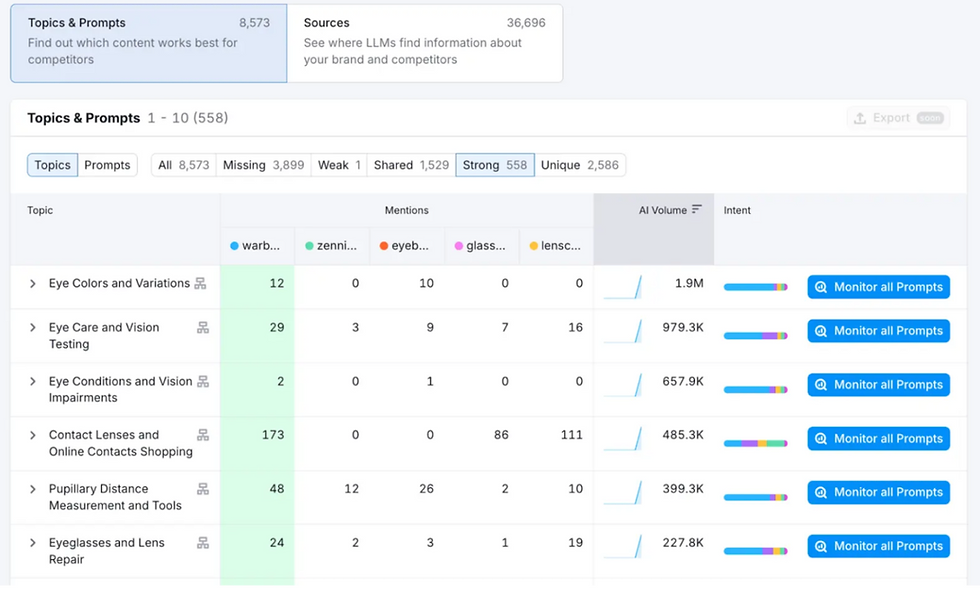
After studying my AI visibility, I’d turn to the Competitor Research report to find out which LLMs reference the competition but not my site.
You can see where you’re outperforming your rivals (the “Strong” tab). And the “Missing” and “Weak” filters uncover areas to improve.
This way, you know where your brand is missing from the conversation. You can then update existing content or create new content around topics that don’t mention your brand to try and secure mentions.
5. Discover What People Ask AI
I’d then use Prompt Research to see what my audience is actually asking AI platforms—and which brands show up in those answers.
You’ll see the prompts people use, the full AI response, brands mentioned, and sources used to inform the answer.

Doing this helps you align your content with real user prompts instead of guessing what people search for. And that can inform the content you create.
6. See How AI Talks About the Brand
After knowing what questions people ask AI, I’d like to know how the resulting AI responses represent my site.
For that, I’d turn to the Brand Performance reports to monitor:
AI share of voice and sentiment against competitors
What’s shaping sentiment and how it changes over time
The questions and citations driving conversations in my niche
The main topics in my niche people ask AI about

At Semrush, we review our LLM share of voice for certain topics. One thing stood out when we did this several months ago: we had a low share of voice for topics around AI monitoring tools.
Our guess? LLMs didn’t know we have AI monitoring tools. Recognizing this helped us shape our strategy for growing our LLM visibility.
How AI represents your brand directly impacts visibility and trust—and finding these gaps early lets you correct the narrative before it defines you.
7. Take Action to Earn More AI Mentions & Citations
Next, I’d focus on taking steps to build my credibility and get more AI mentions and citations by:
Getting online brand mentions
Ensuring information about my brand is consistent—like product names and business details
Creating informative content that AI can easily read and reference
Engaging in places that AI models pull from—like Reddit, YouTube, and LinkedIn
AI may be more likely to cite and mention brands that have a consistent and authoritative online presence.
8. Track the Prompts That Matter Most
Because AI results often shift fast, I’d use Prompt Tracking for daily updates on my visibility.
Tracking prompts helps you spot changes (like when your brand loses visibility in AI conversations), so you can quickly adjust your strategy.
9. Bring SEO and AI Search Together
Lastly, I’d use My Reports to prove the effectiveness of my strategy to stakeholders.
My Reports combines SEO and AI data like mentions, rankings, traffic, and more into one dashboard my team can access anytime.
This report helps you prove the impact of the work you’re doing, so you can secure more budget for your AI and SEO projects.

Bottom Line
Brands that earn AI and SEO visibility are already pulling ahead. Those who are waiting will have to play catch-up.
Are you tracking how your brand shows up in AI search yet? Or still focused only on Google performance?
Comments